Introduction
Each month the Law Library adds new books to our collection. Here is a selection of titles added in the last month. You'll find them on the New Book display by the front desk of the Boley Law Library, or shelved in their proper spot.
Click on the titles to see if they are available. Come to the library and check them out or, literally, come check them out of the library. Faculty, send us your requests and we'll have them in your inbox the next day.
Business, Investment, and Tax Law
-
 Beyond Banks: Technology, Regulation, and the Future of Money
by
How new technology is rapidly changing the nature of money and the way we pay A diverse and growing range of financial institutions and platforms--from PayPal and Venmo to WeChat, Alipay, and the brave new world of stablecoins--has harnessed new technology to disrupt the system of money and payments as we know it. Beyond Banks explains why this disruption holds out the promise of faster, cheaper, more convenient, and more secure payments, but also how it increasingly risks exposing consumers, businesses, and governments to the problem of bad money. Dan Awrey traces the origins of our current bundled system of banking, money, and payments. He explains why the problem of bad money--the result of antiquated and inadequate laws and regulation that fail to establish credible commitments to hold, transfer, or return a customer's money on demand--requires that policymakers fundamentally rethink their approach toward the design of the laws and institutions at the heart of this system. He presents ways to effectively unbundle banking from money and payments, ensure the credibility of monetary commitments, and promote the stability of this system. Awrey also envisions a more forward-looking role for policymakers in encouraging greater technological experimentation, competition, and innovation in the realm of payments. Beyond Banks sheds critical light on the important but too often dysfunctional relationship among technology, regulation, and money, and lays the foundations for a safer, more nimble, and more inclusive system of money and payments.
Call Number: Treatises ; HG1710.3 .A97 2024ISBN: 9780691245423Publication Date: October 22, 2024
Beyond Banks: Technology, Regulation, and the Future of Money
by
How new technology is rapidly changing the nature of money and the way we pay A diverse and growing range of financial institutions and platforms--from PayPal and Venmo to WeChat, Alipay, and the brave new world of stablecoins--has harnessed new technology to disrupt the system of money and payments as we know it. Beyond Banks explains why this disruption holds out the promise of faster, cheaper, more convenient, and more secure payments, but also how it increasingly risks exposing consumers, businesses, and governments to the problem of bad money. Dan Awrey traces the origins of our current bundled system of banking, money, and payments. He explains why the problem of bad money--the result of antiquated and inadequate laws and regulation that fail to establish credible commitments to hold, transfer, or return a customer's money on demand--requires that policymakers fundamentally rethink their approach toward the design of the laws and institutions at the heart of this system. He presents ways to effectively unbundle banking from money and payments, ensure the credibility of monetary commitments, and promote the stability of this system. Awrey also envisions a more forward-looking role for policymakers in encouraging greater technological experimentation, competition, and innovation in the realm of payments. Beyond Banks sheds critical light on the important but too often dysfunctional relationship among technology, regulation, and money, and lays the foundations for a safer, more nimble, and more inclusive system of money and payments.
Call Number: Treatises ; HG1710.3 .A97 2024ISBN: 9780691245423Publication Date: October 22, 2024 -
 Business and Human Rights
by
Business and Human Rights Law is a rapidly growing area of law, which has dramatically transformed many parts of international law. In this new volume in the Elements series, Robert McCorquodale explores how the responsibility for human rights abuses has transitioned from a purely state obligation to also being the responsibility of businesses. Business responsibility for human rights impacts have become subject both to legislation and to court decisions whenever their activities lead to human rights abuses anywhere in the world.This book shows the importance of the UN Guiding Principles on Business and Human Rights in these developments, and examines their influence on international, regional, and national law. It also analyses the changes on state obligations to protect human rights, on the corporate responsibility for human rights abuses, and on effective access to remedies for those adversely affected by business activities. Each of these shifts has consequences on core tenets of international law, such as sovereignty and jurisdiction, and has implications for crafting new international law in areas such as climate change and technology.Robert McCorquodale brings his decades of experience in scholarship and legal practice in business and human rights law, as well as his extensive engagement with businesses, governments, civil society, and international organisations, to bear on his understanding and analysis of this increasingly important field.
Call Number: Treatises ; K1322 .M33 2024ISBN: 9780192855862Publication Date: May 8, 2024
Business and Human Rights
by
Business and Human Rights Law is a rapidly growing area of law, which has dramatically transformed many parts of international law. In this new volume in the Elements series, Robert McCorquodale explores how the responsibility for human rights abuses has transitioned from a purely state obligation to also being the responsibility of businesses. Business responsibility for human rights impacts have become subject both to legislation and to court decisions whenever their activities lead to human rights abuses anywhere in the world.This book shows the importance of the UN Guiding Principles on Business and Human Rights in these developments, and examines their influence on international, regional, and national law. It also analyses the changes on state obligations to protect human rights, on the corporate responsibility for human rights abuses, and on effective access to remedies for those adversely affected by business activities. Each of these shifts has consequences on core tenets of international law, such as sovereignty and jurisdiction, and has implications for crafting new international law in areas such as climate change and technology.Robert McCorquodale brings his decades of experience in scholarship and legal practice in business and human rights law, as well as his extensive engagement with businesses, governments, civil society, and international organisations, to bear on his understanding and analysis of this increasingly important field.
Call Number: Treatises ; K1322 .M33 2024ISBN: 9780192855862Publication Date: May 8, 2024 -
 Corporate Accountability and Liability for Climate Change
by
As litigation rises against corporations and their climate change policies, this timely book examines their accountability and liability for climate change related matters. Covering both national and international law, it investigates approaches to corporate social responsibility, shedding light on how these strategies can help protect human rights and the environment. This book illustrates the potential and limitations of legal doctrines across human rights law, soft law, contract law, consumer law and non-contractual liability law for holding corporations responsible for climate change. The contributing authors explore interconnected aspects of corporate transnational climate law, relating contemporary problems to traditional areas of private law. Ultimately, this prescient book provides valuable legal insights into the challenges of corporate accountability and liability for climate change and identifies important pathways for the future of litigation. Corporate Accountability and Liability for Climate Changeis a valuable resource for students and scholars of corporate social responsibility and climate law and governance. It will also be of relevance to practitioners and policymakers with an interest in litigation and regulatory strategies.
Call Number: Environment ; K955 .C67 2024ISBN: 9781035333219Publication Date: November 29, 2024
Corporate Accountability and Liability for Climate Change
by
As litigation rises against corporations and their climate change policies, this timely book examines their accountability and liability for climate change related matters. Covering both national and international law, it investigates approaches to corporate social responsibility, shedding light on how these strategies can help protect human rights and the environment. This book illustrates the potential and limitations of legal doctrines across human rights law, soft law, contract law, consumer law and non-contractual liability law for holding corporations responsible for climate change. The contributing authors explore interconnected aspects of corporate transnational climate law, relating contemporary problems to traditional areas of private law. Ultimately, this prescient book provides valuable legal insights into the challenges of corporate accountability and liability for climate change and identifies important pathways for the future of litigation. Corporate Accountability and Liability for Climate Changeis a valuable resource for students and scholars of corporate social responsibility and climate law and governance. It will also be of relevance to practitioners and policymakers with an interest in litigation and regulatory strategies.
Call Number: Environment ; K955 .C67 2024ISBN: 9781035333219Publication Date: November 29, 2024 -
 Deals: The Economi Structure of Business Transactions
by
Drawing on real-life cases from a wide range of industries, two acclaimed experts offer a sophisticated but accessible guide to business deals, designed to maximize value for your side. Business transactions take widely varying forms--from multibillion-dollar corporate mergers to patent licenses to the signing of an all-star quarterback. Yet every deal shares the same goal, or at least should: to maximize the joint value created and to distribute that value among the parties. Building on decades of experience teaching and advising on business deals, Michael Klausner and Guhan Subramanian show how to accomplish this goal through rigorous attention to designing incentives, conveying information, and specifying parties' rights and obligations. Deals captures the range of real-life transactional complexities with case studies covering Microsoft's acquisition of LinkedIn, Scarlett Johansson's contract dispute with Disney over the release of Black Widow, litigation surrounding LVMH's pandemic-disrupted acquisition of Tiffany, the feud between George Norcross and Lewis Katz over ownership of the Philadelphia Inquirer, NBC/Viacom's negotiation with Paramount over the final three seasons of Frasier, and many more. In clear, concise terms, Klausner and Subramanian establish the basic framework of negotiation and the economic concepts that must be addressed in order to maximize value. They show how to tackle challenges, such as information asymmetry between buyer and seller, moral hazard, and opportunistic behavior. And the authors lay out responses to common risks associated with long-term contracts, emphasizing that a deal's exit rights should be carefully considered at the start of transaction design. Unique in its practical application of economic theory to actual dealmaking, this book will be an indispensable resource for students and for professionals across the business and legal world.
Call Number: Treatises ; HD58.6 .K574 2024ISBN: 9780674495159Publication Date: March 19, 2024
Deals: The Economi Structure of Business Transactions
by
Drawing on real-life cases from a wide range of industries, two acclaimed experts offer a sophisticated but accessible guide to business deals, designed to maximize value for your side. Business transactions take widely varying forms--from multibillion-dollar corporate mergers to patent licenses to the signing of an all-star quarterback. Yet every deal shares the same goal, or at least should: to maximize the joint value created and to distribute that value among the parties. Building on decades of experience teaching and advising on business deals, Michael Klausner and Guhan Subramanian show how to accomplish this goal through rigorous attention to designing incentives, conveying information, and specifying parties' rights and obligations. Deals captures the range of real-life transactional complexities with case studies covering Microsoft's acquisition of LinkedIn, Scarlett Johansson's contract dispute with Disney over the release of Black Widow, litigation surrounding LVMH's pandemic-disrupted acquisition of Tiffany, the feud between George Norcross and Lewis Katz over ownership of the Philadelphia Inquirer, NBC/Viacom's negotiation with Paramount over the final three seasons of Frasier, and many more. In clear, concise terms, Klausner and Subramanian establish the basic framework of negotiation and the economic concepts that must be addressed in order to maximize value. They show how to tackle challenges, such as information asymmetry between buyer and seller, moral hazard, and opportunistic behavior. And the authors lay out responses to common risks associated with long-term contracts, emphasizing that a deal's exit rights should be carefully considered at the start of transaction design. Unique in its practical application of economic theory to actual dealmaking, this book will be an indispensable resource for students and for professionals across the business and legal world.
Call Number: Treatises ; HD58.6 .K574 2024ISBN: 9780674495159Publication Date: March 19, 2024 -
 Untaxed: The RIch, the IRS, and a New Approach to Tax Compliance
by
One of the most common complaints about the tax system in the United States is that rich taxpayers are able to lower their tax liabilities through abusive tax practices, often outmaneuvering the Internal Revenue Service (IRS). Untaxed offers a fresh perspective on the long-standing dilemma of tax avoidance and evasion by the rich by proposing a new legal response: means-based adjustments to the tax compliance rules. These compliance rules govern interactions between taxpayers and the IRS, from filing tax returns to responding to audit letters to paying tax penalties. Untaxed shows how tax compliance rules can be adjusted based on taxpayers' means to level the playing field between the rich and everyone else. Timely and innovative, this book is a must-read for legal scholars, policymakers, tax students, and anyone interested in tax policy and administration.
Call Number: Treatises ; KF6310 .B53 2025ISBN: 9781009198714Publication Date: November 28, 2024
Untaxed: The RIch, the IRS, and a New Approach to Tax Compliance
by
One of the most common complaints about the tax system in the United States is that rich taxpayers are able to lower their tax liabilities through abusive tax practices, often outmaneuvering the Internal Revenue Service (IRS). Untaxed offers a fresh perspective on the long-standing dilemma of tax avoidance and evasion by the rich by proposing a new legal response: means-based adjustments to the tax compliance rules. These compliance rules govern interactions between taxpayers and the IRS, from filing tax returns to responding to audit letters to paying tax penalties. Untaxed shows how tax compliance rules can be adjusted based on taxpayers' means to level the playing field between the rich and everyone else. Timely and innovative, this book is a must-read for legal scholars, policymakers, tax students, and anyone interested in tax policy and administration.
Call Number: Treatises ; KF6310 .B53 2025ISBN: 9781009198714Publication Date: November 28, 2024


Civil Rights and Constitutional Law
-
 Pardon Power
by
The president's power to pardon federal crimes is immense, with roots in ancient notions of mercy and amnesty. However, this power, seemingly boundless under the Constitution, lacks clear constraints, inviting concerns about abuse. Recent discussions in the U.S. Supreme Court have raised alarms about the potential for presidential abuse of pardons, highlighting the need for accountability within the pardon system to uphold the foundational premise that no one is above the law. Pardon Power: How the Pardon System Works-- and Why, Kim Wehle explores the historical context and contemporary challenges surrounding the presidential pardon. Wehle contends that any pardon undermining the principle of accountability before the law, including self-pardons, cannot be constitutionally justified. Urgent recognition of the necessity for guardrails around the pardon power is essential to safeguard American democracy.
Call Number: Treatises ; KF9695 .W44 2024ISBN: 9781954907508Publication Date: September 2, 2024
Pardon Power
by
The president's power to pardon federal crimes is immense, with roots in ancient notions of mercy and amnesty. However, this power, seemingly boundless under the Constitution, lacks clear constraints, inviting concerns about abuse. Recent discussions in the U.S. Supreme Court have raised alarms about the potential for presidential abuse of pardons, highlighting the need for accountability within the pardon system to uphold the foundational premise that no one is above the law. Pardon Power: How the Pardon System Works-- and Why, Kim Wehle explores the historical context and contemporary challenges surrounding the presidential pardon. Wehle contends that any pardon undermining the principle of accountability before the law, including self-pardons, cannot be constitutionally justified. Urgent recognition of the necessity for guardrails around the pardon power is essential to safeguard American democracy.
Call Number: Treatises ; KF9695 .W44 2024ISBN: 9781954907508Publication Date: September 2, 2024 -
 Written and Unwritten: The Rules, Internal Procedures, and Customs of the United States Court of Appeals
by
Although the thirteen United States Courts of Appeals are the final word on 99 percent of all federal cases, there is no detailed account of how these courts operate. How do judges decide which decisions are binding precedents and which are not? Who decides whether appeals are argued orally? What administrative structures do these Courts have? The answers to these and hundreds of other questions are largely unknown, not only to lawyers and legal academics, but by many within the judiciary itself. Written and Unwritten is the first book to provide an inside look at how these courts operate. An unprecedented contribution to the field of judicial administration, the book collects the differing local rules and internal procedures of each Court of Appeals. In-depth interviews of the Chief Judges of all thirteen circuits and surveys of all Clerks of Court reveal previously undisclosed practices and customs.
Call Number: Treatises ; KF9053 .N49 2024ISBN: 9781009426190Publication Date: November 21, 2024
Written and Unwritten: The Rules, Internal Procedures, and Customs of the United States Court of Appeals
by
Although the thirteen United States Courts of Appeals are the final word on 99 percent of all federal cases, there is no detailed account of how these courts operate. How do judges decide which decisions are binding precedents and which are not? Who decides whether appeals are argued orally? What administrative structures do these Courts have? The answers to these and hundreds of other questions are largely unknown, not only to lawyers and legal academics, but by many within the judiciary itself. Written and Unwritten is the first book to provide an inside look at how these courts operate. An unprecedented contribution to the field of judicial administration, the book collects the differing local rules and internal procedures of each Court of Appeals. In-depth interviews of the Chief Judges of all thirteen circuits and surveys of all Clerks of Court reveal previously undisclosed practices and customs.
Call Number: Treatises ; KF9053 .N49 2024ISBN: 9781009426190Publication Date: November 21, 2024 -
 Homelessness, Liberty and Property
by
In Homelessness, Liberty and Property, Terry Skolnik establishes a novel theory about the government's duties to end homelessness, maintain public property's value, and legitimize laws that regulate public space. In doing so, Skolnik provides new insight into how the property law system and the regulation of public space limit unhoused persons' freedom and political equality. The book deepens our understanding of how various areas of law, such as constitutional law, legal philosophy, criminal law, and property law, approach the reality of homelessness and advances original arguments to provide new justifications for the right to housing. Skolnik concludes by offering a set of concrete proposals for how the government can reduce the incidence of homelessness and treat unhoused persons with greater concern and respect.
Call Number: Treatises ; KF3742 .S56 2025ISBN: 9781009392679Publication Date: November 2021, 2024
Homelessness, Liberty and Property
by
In Homelessness, Liberty and Property, Terry Skolnik establishes a novel theory about the government's duties to end homelessness, maintain public property's value, and legitimize laws that regulate public space. In doing so, Skolnik provides new insight into how the property law system and the regulation of public space limit unhoused persons' freedom and political equality. The book deepens our understanding of how various areas of law, such as constitutional law, legal philosophy, criminal law, and property law, approach the reality of homelessness and advances original arguments to provide new justifications for the right to housing. Skolnik concludes by offering a set of concrete proposals for how the government can reduce the incidence of homelessness and treat unhoused persons with greater concern and respect.
Call Number: Treatises ; KF3742 .S56 2025ISBN: 9781009392679Publication Date: November 2021, 2024


Criminal Law
-
 Anxiety Culture: The New Global State of Human Affairs
by
A collection of timely essays on the rising wave of anxiety in culture. The twenty-first century is characterized by uncertainty: from catastrophic climate change to the accelerating pace of technological change, societies around the world are gripped by anxiety about the future. In Anxiety Culture, editors John Allegrante, Ulrich Hoinkes, Michael Schapira, and Karen Struve bring together a distinguished group of international scholars to examine the forces that increase anxiety as a phenomenon beyond solely individual experiences of clinical anxiety to pervade global culture. These trenchant essays examine our culture of anxiety across diverse avenues of society. Covering fears related to climate change, populist and extremist movements around the world, gun violence, artificial intelligence, and more, contributors also examine how anxiety is expressed in literature and the media and how a culture of anxiety affects policymaking. Chapters are organized into five sections: disciplinary perspectives on anxiety, climate change and the environment, population health and social well-being, migration, and technology. There's room for hope, however. Contributors provide pragmatic recommendations for coping with anxiety culture in public education, governments, and NGOs. Anxiety Culture is a unique attempt to define this condition and an indispensable resource for those seeking stability in an unstable age, providing a set of conceptual and practical narratives for navigating both existing and emergent planetary challenges.
Call Number: Treatises ; BF575.A6 A77 2024ISBN: 9781421450360Publication Date: November 12, 2024
Anxiety Culture: The New Global State of Human Affairs
by
A collection of timely essays on the rising wave of anxiety in culture. The twenty-first century is characterized by uncertainty: from catastrophic climate change to the accelerating pace of technological change, societies around the world are gripped by anxiety about the future. In Anxiety Culture, editors John Allegrante, Ulrich Hoinkes, Michael Schapira, and Karen Struve bring together a distinguished group of international scholars to examine the forces that increase anxiety as a phenomenon beyond solely individual experiences of clinical anxiety to pervade global culture. These trenchant essays examine our culture of anxiety across diverse avenues of society. Covering fears related to climate change, populist and extremist movements around the world, gun violence, artificial intelligence, and more, contributors also examine how anxiety is expressed in literature and the media and how a culture of anxiety affects policymaking. Chapters are organized into five sections: disciplinary perspectives on anxiety, climate change and the environment, population health and social well-being, migration, and technology. There's room for hope, however. Contributors provide pragmatic recommendations for coping with anxiety culture in public education, governments, and NGOs. Anxiety Culture is a unique attempt to define this condition and an indispensable resource for those seeking stability in an unstable age, providing a set of conceptual and practical narratives for navigating both existing and emergent planetary challenges.
Call Number: Treatises ; BF575.A6 A77 2024ISBN: 9781421450360Publication Date: November 12, 2024 -
 Arson and Fire Investigation: A Legal Research Guide
by
Arson is a violent crime that has caused millions of dollars in property damage and widespread injuries and fatalities. In 2022, 30,400 incidents of arson were reported by law enforcement agencies to the FBI's National Incident Based Reporting System (NIBRS). However, the crime of arson is difficult to investigate and prosecute as it involves many complex challenges. The FBI's Uniform Crime Report program reported an arson crime clearance rate in 2019 of 23.4%. As the field of fire investigation evolves and continues to become more solidly grounded in science, there is an increasing need for resource material for the professionals involved in legal action related to fire investigation and arson. The authors have put together critical references in one resource to aid professionals in the legal system, law enforcement, and fire investigation community. It is the hope of the authors that this reference will continue the improve the understanding of fire investigation and will assist in the challenging pursuit of truth in arson cases. This bibliography follows previous bibliographies with citations to both primary and secondary sources. We have included both scientific and legal sources for the readers of this bibliography.
Call Number: Treatises ; KF241 .F57 F57 2025ISBN: 9780837743264Publication Date: 2025
Arson and Fire Investigation: A Legal Research Guide
by
Arson is a violent crime that has caused millions of dollars in property damage and widespread injuries and fatalities. In 2022, 30,400 incidents of arson were reported by law enforcement agencies to the FBI's National Incident Based Reporting System (NIBRS). However, the crime of arson is difficult to investigate and prosecute as it involves many complex challenges. The FBI's Uniform Crime Report program reported an arson crime clearance rate in 2019 of 23.4%. As the field of fire investigation evolves and continues to become more solidly grounded in science, there is an increasing need for resource material for the professionals involved in legal action related to fire investigation and arson. The authors have put together critical references in one resource to aid professionals in the legal system, law enforcement, and fire investigation community. It is the hope of the authors that this reference will continue the improve the understanding of fire investigation and will assist in the challenging pursuit of truth in arson cases. This bibliography follows previous bibliographies with citations to both primary and secondary sources. We have included both scientific and legal sources for the readers of this bibliography.
Call Number: Treatises ; KF241 .F57 F57 2025ISBN: 9780837743264Publication Date: 2025 -
 Framed: Astonishing True Stories of Wrongful Convictions
by
"The master of the legal thriller" (Associated Press) teams up with "the godfather of the innocence movement" (Texas Monthly) to share ten harrowing true stories of wrongful convictions. John Grisham is known worldwide for his bestselling novels, but it's his real-life passion for justice that led to his work with Jim McCloskey of Centurion Ministries, the first organization dedicated to exonerating innocent people who have been wrongly convicted. Together they offer an inside look at the many injustices in our criminal justice system. A fundamental principle of our legal system is a presumption of innocence, but once someone has been found guilty, there is very little room to prove doubt. These ten true stories shed light on Americans who were innocent but found guilty and forced to sacrifice friends, families, and decades of their lives to prison while the guilty parties remained free. In each of the stories, John Grisham and Jim McCloskey recount the dramatic hard-fought battles for exoneration. They take a close look at what leads to wrongful convictions in the first place and the racism, misconduct, flawed testimony, and corruption in the court system that can make them so hard to reverse. Impeccably researched and told with page-turning suspense as only John Grisham can deliver, Framed is the story of winning freedom when the battle already seems lost and the deck is stacked against you.
Call Number: Treatises ; HV7419.3 .G75 2024ISBN: 9780385550444Publication Date: 2024-10-15
Framed: Astonishing True Stories of Wrongful Convictions
by
"The master of the legal thriller" (Associated Press) teams up with "the godfather of the innocence movement" (Texas Monthly) to share ten harrowing true stories of wrongful convictions. John Grisham is known worldwide for his bestselling novels, but it's his real-life passion for justice that led to his work with Jim McCloskey of Centurion Ministries, the first organization dedicated to exonerating innocent people who have been wrongly convicted. Together they offer an inside look at the many injustices in our criminal justice system. A fundamental principle of our legal system is a presumption of innocence, but once someone has been found guilty, there is very little room to prove doubt. These ten true stories shed light on Americans who were innocent but found guilty and forced to sacrifice friends, families, and decades of their lives to prison while the guilty parties remained free. In each of the stories, John Grisham and Jim McCloskey recount the dramatic hard-fought battles for exoneration. They take a close look at what leads to wrongful convictions in the first place and the racism, misconduct, flawed testimony, and corruption in the court system that can make them so hard to reverse. Impeccably researched and told with page-turning suspense as only John Grisham can deliver, Framed is the story of winning freedom when the battle already seems lost and the deck is stacked against you.
Call Number: Treatises ; HV7419.3 .G75 2024ISBN: 9780385550444Publication Date: 2024-10-15 -
 Utmost Resistance: Examining Sexual Violence Law in the United States
by
Despite greater social awareness and intense media coverage of high-profile sexual assault cases, the vast majority of such crimes still go either unreported or unprosecuted. Why? The answer lies in the patchwork of laws governing such crimes and the often sexist and racist roots that underlie them. Utmost Resistance: Examining Sexual Violence Law in the United States discusses the history of sexual violence laws, the social and media forces that drive the laws, and the progress American society has made in recognizing and punishing such behavior. The chapters cover a range of subjects including federal regulations such as Title IX and Title VII, sentencing, children and sexual violence, pornography, and evidence, as well as the evolution of legal concepts such as force and consent. The textbook, with accompanying teacher's manual, suggested course design, and notes and questions, was created to be used in a seminar or large class format, either for graduate or undergraduate students.
Call Number: Treatises ; KF9325 .V67 2024ISBN: 9781531026349Publication Date: January 1, 2024
Utmost Resistance: Examining Sexual Violence Law in the United States
by
Despite greater social awareness and intense media coverage of high-profile sexual assault cases, the vast majority of such crimes still go either unreported or unprosecuted. Why? The answer lies in the patchwork of laws governing such crimes and the often sexist and racist roots that underlie them. Utmost Resistance: Examining Sexual Violence Law in the United States discusses the history of sexual violence laws, the social and media forces that drive the laws, and the progress American society has made in recognizing and punishing such behavior. The chapters cover a range of subjects including federal regulations such as Title IX and Title VII, sentencing, children and sexual violence, pornography, and evidence, as well as the evolution of legal concepts such as force and consent. The textbook, with accompanying teacher's manual, suggested course design, and notes and questions, was created to be used in a seminar or large class format, either for graduate or undergraduate students.
Call Number: Treatises ; KF9325 .V67 2024ISBN: 9781531026349Publication Date: January 1, 2024


Diversity, Equity, and Inclusion
-
 Empire of Purity: The History of Americans' Global War on Prostitution
by
Between the 1870s and 1930s, American social reformers, working closely with the US government, transformed sexual vice into an international political and humanitarian concern. As these activists worked to eradicate prostitution and trafficking, they promoted sexual self-control for both men and women as a cornerstone of civilization and a basis of American exceptionalism. Empire of Purity traces the history of these efforts, showing how the policing and penalization of sexuality was used to justify American interventions around the world. Eva Payne describes how American reformers successfully pushed for international anti-trafficking agreements that mirrored US laws, calling for states to criminalize prostitution and restrict migration, and harming the very women they claimed to protect. She argues that Americans' ambitions to reshape global sexual morality and law advanced an ideology of racial hierarchy that viewed women of color, immigrants, and sexual minorities as dangerous vectors of disease. Payne tells the stories of the sex workers themselves, revealing how these women's experiences defy the dichotomies that have shaped American cultural and legal conceptions of prostitution and trafficking, such as choice and coercion, free and unfree labor, and white sexual innocence and the assumed depravity of nonwhites. Drawing on archives in Europe, the United States, and Latin America, Empire of Purity ties the war on sexual vice to American imperial ambitions and a politicization of sexuality that continues to govern both domestic and international policy today.
Call Number: Treatises ; HQ144 .P39 2024ISBN: 9780691256979Publication Date: November 12, 2024
Empire of Purity: The History of Americans' Global War on Prostitution
by
Between the 1870s and 1930s, American social reformers, working closely with the US government, transformed sexual vice into an international political and humanitarian concern. As these activists worked to eradicate prostitution and trafficking, they promoted sexual self-control for both men and women as a cornerstone of civilization and a basis of American exceptionalism. Empire of Purity traces the history of these efforts, showing how the policing and penalization of sexuality was used to justify American interventions around the world. Eva Payne describes how American reformers successfully pushed for international anti-trafficking agreements that mirrored US laws, calling for states to criminalize prostitution and restrict migration, and harming the very women they claimed to protect. She argues that Americans' ambitions to reshape global sexual morality and law advanced an ideology of racial hierarchy that viewed women of color, immigrants, and sexual minorities as dangerous vectors of disease. Payne tells the stories of the sex workers themselves, revealing how these women's experiences defy the dichotomies that have shaped American cultural and legal conceptions of prostitution and trafficking, such as choice and coercion, free and unfree labor, and white sexual innocence and the assumed depravity of nonwhites. Drawing on archives in Europe, the United States, and Latin America, Empire of Purity ties the war on sexual vice to American imperial ambitions and a politicization of sexuality that continues to govern both domestic and international policy today.
Call Number: Treatises ; HQ144 .P39 2024ISBN: 9780691256979Publication Date: November 12, 2024 -
 Social Movements and the Law: Talking about Black Lives Matter and #METOO
by
Black Lives Matter and #MeToo are two of the most prominent twenty-first-century social movements in the United States. On the ground and on social media, more people have taken an active stance in support of either or both movements than almost any others in the country's history. Social Movements and the Law brings together the voices of twelve scholars and public intellectuals to explore how Black Lives Matter and #MeToo unfolded--separately and together--and how they enrich, inform, and complicate each other. Structured in dialogues and punctuated with informative text boxes, illustrations, and discussion questions, this accessible guide to an increasingly influential area of the law centers rich intersectional analysis of both movements and prompts readers to undertake further reflection and conversation. At a time of heightened public attention to the broader scholarly study of human social behavior and interaction, this book shows rather than tells how people with different perspectives can engage one another with open minds and a generosity of spirit.
ISBN: 9780520385160Publication Date: November 12, 2024
Social Movements and the Law: Talking about Black Lives Matter and #METOO
by
Black Lives Matter and #MeToo are two of the most prominent twenty-first-century social movements in the United States. On the ground and on social media, more people have taken an active stance in support of either or both movements than almost any others in the country's history. Social Movements and the Law brings together the voices of twelve scholars and public intellectuals to explore how Black Lives Matter and #MeToo unfolded--separately and together--and how they enrich, inform, and complicate each other. Structured in dialogues and punctuated with informative text boxes, illustrations, and discussion questions, this accessible guide to an increasingly influential area of the law centers rich intersectional analysis of both movements and prompts readers to undertake further reflection and conversation. At a time of heightened public attention to the broader scholarly study of human social behavior and interaction, this book shows rather than tells how people with different perspectives can engage one another with open minds and a generosity of spirit.
ISBN: 9780520385160Publication Date: November 12, 2024 -
Utmost Resistance: Examining Sexual Violence Law in the United States
by
Despite greater social awareness and intense media coverage of high-profile sexual assault cases, the vast majority of such crimes still go either unreported or unprosecuted. Why? The answer lies in the patchwork of laws governing such crimes and the often sexist and racist roots that underlie them. Utmost Resistance: Examining Sexual Violence Law in the United States discusses the history of sexual violence laws, the social and media forces that drive the laws, and the progress American society has made in recognizing and punishing such behavior. The chapters cover a range of subjects including federal regulations such as Title IX and Title VII, sentencing, children and sexual violence, pornography, and evidence, as well as the evolution of legal concepts such as force and consent. The textbook, with accompanying teacher's manual, suggested course design, and notes and questions, was created to be used in a seminar or large class format, either for graduate or undergraduate students.
Call Number: Treatises ; KF9325 .V67 2024ISBN: 9781531026349Publication Date: January 1, 2024
-
 We Could Have Been Friends, My Father and I
by
Finalist for the National Book Award and Los Angeles Times Book Prize. A subtle psychological portrait of the author's relationship with his father during the twentieth-century battle for Palestinian human rights. Aziz Shehadeh was many things: lawyer, activist, and political detainee. He was also the father of bestselling author and activist Raja. In this new and searingly personal memoir, Raja Shehadeh unpacks the snags and complexities of their relationship. A vocal and fearless opponent, Aziz resists under the British mandatory period, then under Jordan, and, finally, under Israel. As a young man, Raja fails to recognize his father's courage and, in turn, his father does not appreciate Raja's own efforts in campaigning for Palestinian human rights. When Aziz is murdered in 1985, it changes Raja irrevocably. This is not only the story of the battle against the various oppressors of the Palestinians, but a moving portrait of a particular father and son relationship.
Call Number: Treatises ; DS125.3.S485 A3 2024ISBN: 9781635425239Publication Date: September 24, 2024
We Could Have Been Friends, My Father and I
by
Finalist for the National Book Award and Los Angeles Times Book Prize. A subtle psychological portrait of the author's relationship with his father during the twentieth-century battle for Palestinian human rights. Aziz Shehadeh was many things: lawyer, activist, and political detainee. He was also the father of bestselling author and activist Raja. In this new and searingly personal memoir, Raja Shehadeh unpacks the snags and complexities of their relationship. A vocal and fearless opponent, Aziz resists under the British mandatory period, then under Jordan, and, finally, under Israel. As a young man, Raja fails to recognize his father's courage and, in turn, his father does not appreciate Raja's own efforts in campaigning for Palestinian human rights. When Aziz is murdered in 1985, it changes Raja irrevocably. This is not only the story of the battle against the various oppressors of the Palestinians, but a moving portrait of a particular father and son relationship.
Call Number: Treatises ; DS125.3.S485 A3 2024ISBN: 9781635425239Publication Date: September 24, 2024


Environmental, Energy, and Natural Resources Law
-
Anxiety Culture: The New Global State of Human Affairs
by
A collection of timely essays on the rising wave of anxiety in culture. The twenty-first century is characterized by uncertainty: from catastrophic climate change to the accelerating pace of technological change, societies around the world are gripped by anxiety about the future. In Anxiety Culture, editors John Allegrante, Ulrich Hoinkes, Michael Schapira, and Karen Struve bring together a distinguished group of international scholars to examine the forces that increase anxiety as a phenomenon beyond solely individual experiences of clinical anxiety to pervade global culture. These trenchant essays examine our culture of anxiety across diverse avenues of society. Covering fears related to climate change, populist and extremist movements around the world, gun violence, artificial intelligence, and more, contributors also examine how anxiety is expressed in literature and the media and how a culture of anxiety affects policymaking. Chapters are organized into five sections: disciplinary perspectives on anxiety, climate change and the environment, population health and social well-being, migration, and technology. There's room for hope, however. Contributors provide pragmatic recommendations for coping with anxiety culture in public education, governments, and NGOs. Anxiety Culture is a unique attempt to define this condition and an indispensable resource for those seeking stability in an unstable age, providing a set of conceptual and practical narratives for navigating both existing and emergent planetary challenges.
Call Number: Treatises ; BF575.A6 A77 2024ISBN: 9781421450360Publication Date: November 12, 2024
-
Corporate Accountability and Liability for Climate Change
by
As litigation rises against corporations and their climate change policies, this timely book examines their accountability and liability for climate change related matters. Covering both national and international law, it investigates approaches to corporate social responsibility, shedding light on how these strategies can help protect human rights and the environment. This book illustrates the potential and limitations of legal doctrines across human rights law, soft law, contract law, consumer law and non-contractual liability law for holding corporations responsible for climate change. The contributing authors explore interconnected aspects of corporate transnational climate law, relating contemporary problems to traditional areas of private law. Ultimately, this prescient book provides valuable legal insights into the challenges of corporate accountability and liability for climate change and identifies important pathways for the future of litigation. Corporate Accountability and Liability for Climate Changeis a valuable resource for students and scholars of corporate social responsibility and climate law and governance. It will also be of relevance to practitioners and policymakers with an interest in litigation and regulatory strategies.
Call Number: Environment ; K955 .C67 2024ISBN: 9781035333219Publication Date: November 29, 2024
-
 Sailing Across a Wounded Sea
by
The capacity of humans to destroy their environment is playing out like a Greek tragedy in the Mediterranean Sea. After having coexisted with a diversity of marine animals throughout their history, humans have broken the balance in recent decades, and the survival of countless marine creatures is now increasingly uncertain. However, unlike in classical tragedies, real-life entities are not necessarily doomed by their fate, and there must be hope to turn the tide in nature''s favour. Lack of concrete conservation action might be simply due to a lack of awareness: how can we feel sad about a loss if we don''t know what we are losing? "Sailing Across a Wounded Sea" is the story of an ideal journey around the Mediterranean to meet its non-human inhabitants, consisting of real episodes collected over half a century as the author observed real animals, exchanged views with a variety of contacts, and argued for such views in the policy arena. Encountering whales, dolphins, seals and rays in their habitat and on their terms will hopefully contribute to building up in readers a collective commitment to help secure a future for these species. A future where they are allowed to flourish as they were meant to - had humans never trod so heavily on the sea's delicate ecological balance and the interwoven natural processes. Giuseppe Notarbartolo di Sciara has been involved for a lifetime in protecting marine biodiversity in various capacities - as a scientist, civil servant, advocate and sailor. Having studied in California and worked with whales, dolphins and sharks worldwide, he returned to the Mediterranean in 1985, keen on using his acquired tools to discover more about the ancient sea''s natural history. Here, he described small but vibrant populations of fin and sperm whales, along with various species of dolphins, manta rays and the monk seal. At the same time, seeing the Mediterranean''s progressive degradation at the hands of humans, he felt a surge of rebellion against this squandering of natural values, and wished to raise awareness of the existence of these marine natural treasures and the risk of losing them.
Call Number: Environment ; QH541.5.W3 N727 2024ISBN: 9783031545962Publication Date: June 18, 2024
Sailing Across a Wounded Sea
by
The capacity of humans to destroy their environment is playing out like a Greek tragedy in the Mediterranean Sea. After having coexisted with a diversity of marine animals throughout their history, humans have broken the balance in recent decades, and the survival of countless marine creatures is now increasingly uncertain. However, unlike in classical tragedies, real-life entities are not necessarily doomed by their fate, and there must be hope to turn the tide in nature''s favour. Lack of concrete conservation action might be simply due to a lack of awareness: how can we feel sad about a loss if we don''t know what we are losing? "Sailing Across a Wounded Sea" is the story of an ideal journey around the Mediterranean to meet its non-human inhabitants, consisting of real episodes collected over half a century as the author observed real animals, exchanged views with a variety of contacts, and argued for such views in the policy arena. Encountering whales, dolphins, seals and rays in their habitat and on their terms will hopefully contribute to building up in readers a collective commitment to help secure a future for these species. A future where they are allowed to flourish as they were meant to - had humans never trod so heavily on the sea's delicate ecological balance and the interwoven natural processes. Giuseppe Notarbartolo di Sciara has been involved for a lifetime in protecting marine biodiversity in various capacities - as a scientist, civil servant, advocate and sailor. Having studied in California and worked with whales, dolphins and sharks worldwide, he returned to the Mediterranean in 1985, keen on using his acquired tools to discover more about the ancient sea''s natural history. Here, he described small but vibrant populations of fin and sperm whales, along with various species of dolphins, manta rays and the monk seal. At the same time, seeing the Mediterranean''s progressive degradation at the hands of humans, he felt a surge of rebellion against this squandering of natural values, and wished to raise awareness of the existence of these marine natural treasures and the risk of losing them.
Call Number: Environment ; QH541.5.W3 N727 2024ISBN: 9783031545962Publication Date: June 18, 2024 -
 Valley So Low
by
A NEW YORKER BEST BOOK OF THE YEAR A riveting courtroom drama about the victims of one of the largest environmental disasters in U.S. history--and the country lawyer determined to challenge the notion that, in America, justice can be bought. For more than fifty years, a power plant in the small town of Kingston, Tennessee, burned fourteen thousand tons of coal a day, gradually creating a mountain of ashen waste sixty feet high and covering eighty-four acres, contained only by an earthen embankment. In 2008, just before Christmas, that embankment broke, unleashing a lethal wave of coal sludge that covered three hundred acres, damaged nearly thirty homes, and precipitating a cleanup effort that would cost more than a billion dollars--and the lives of more than fifty cleanup workers who inhaled the toxins it released. Jim Scott, a local personal-injury lawyer, agreed to represent the workers after they began to fall ill. That meant doing legal battle against the Tennessee Valley Authority, a colossal, federally owned power company that had once been a famous cornerstone of President Franklin D. Roosevelt's New Deal. Scott and his hastily assembled team gathered extensive evidence of malfeasance: threats against workers; retaliatory firings; disregarded safety precautions; and test results, either hidden or altered, that would have revealed harmful concentrations of arsenic, lead, and radioactive materials at the cleanup site. At every stage, Scott--outmanned and nearly broke--had to overcome legal hurdles constructed by TVA and the firm it hired to help execute the cleanup. He grew especially close to one of the victims, whose swift decline only intensified his hunger for justice. As the incriminating evidence mounted, the workers seemed to have everything on their side, including the truth--and yet, was it all enough to prevail? The lawsuit that Scott pursued on the workers' behalf was about their illnesses, no doubt. But it was also about whether blue-collar employees could beat the C-suite; if self-described "hillbilly lawyers" could beat elite corporate defense attorneys; and whether strong evidence could beat fat pocketbooks. With suspense and rich detail, Jared Sullivan's thrilling account lays bare the casual brutality of the American justice system, and calls into question whether--and how--the federal government has failed its people.
Call Number: Environment ; KFT354 .S85 2024ISBN: 9780593321119Publication Date: October 15, 2024
Valley So Low
by
A NEW YORKER BEST BOOK OF THE YEAR A riveting courtroom drama about the victims of one of the largest environmental disasters in U.S. history--and the country lawyer determined to challenge the notion that, in America, justice can be bought. For more than fifty years, a power plant in the small town of Kingston, Tennessee, burned fourteen thousand tons of coal a day, gradually creating a mountain of ashen waste sixty feet high and covering eighty-four acres, contained only by an earthen embankment. In 2008, just before Christmas, that embankment broke, unleashing a lethal wave of coal sludge that covered three hundred acres, damaged nearly thirty homes, and precipitating a cleanup effort that would cost more than a billion dollars--and the lives of more than fifty cleanup workers who inhaled the toxins it released. Jim Scott, a local personal-injury lawyer, agreed to represent the workers after they began to fall ill. That meant doing legal battle against the Tennessee Valley Authority, a colossal, federally owned power company that had once been a famous cornerstone of President Franklin D. Roosevelt's New Deal. Scott and his hastily assembled team gathered extensive evidence of malfeasance: threats against workers; retaliatory firings; disregarded safety precautions; and test results, either hidden or altered, that would have revealed harmful concentrations of arsenic, lead, and radioactive materials at the cleanup site. At every stage, Scott--outmanned and nearly broke--had to overcome legal hurdles constructed by TVA and the firm it hired to help execute the cleanup. He grew especially close to one of the victims, whose swift decline only intensified his hunger for justice. As the incriminating evidence mounted, the workers seemed to have everything on their side, including the truth--and yet, was it all enough to prevail? The lawsuit that Scott pursued on the workers' behalf was about their illnesses, no doubt. But it was also about whether blue-collar employees could beat the C-suite; if self-described "hillbilly lawyers" could beat elite corporate defense attorneys; and whether strong evidence could beat fat pocketbooks. With suspense and rich detail, Jared Sullivan's thrilling account lays bare the casual brutality of the American justice system, and calls into question whether--and how--the federal government has failed its people.
Call Number: Environment ; KFT354 .S85 2024ISBN: 9780593321119Publication Date: October 15, 2024 -
 Wild Forest Home: Stories of Conservation in the Pacific Northwest
by
Growing up in the Pacific Northwest, Betsy L. Howell spent her childhood exploring and thriving in old-growth coniferous forests. In the summer of 1986, she volunteered in Mt. Hood National Forest, surveying northern spotted owls. That summer position turned into three decades as a wildlife biologist with the U.S. Forest Service during a time of tremendous change within the agency. The twenty-five essays in Wild Forest Home chronicle Howell's career and personal experiences studying the wildlife of the Pacific Northwest during the litigious listing of the northern spotted owl and marbled murrelet under the Endangered Species Act and the Clinton administration's adoption of the seminal 1994 Northwest Forest Plan. Meanwhile, Howell toiled on fire crews, searched for rare species, helped to monitor fishers reintroduced to the Olympic Peninsula, tested amphibians for deadly diseases, became a writer, and mourned the deaths of her parents. This captivating memoir seamlessly blends story and science to reveal a unique portrait of the struggles and joys of one wildlife biologist.
Call Number: Environment ; QH31.H32 H68 2024ISBN: 9781647691943Publication Date: November 15, 2024
Wild Forest Home: Stories of Conservation in the Pacific Northwest
by
Growing up in the Pacific Northwest, Betsy L. Howell spent her childhood exploring and thriving in old-growth coniferous forests. In the summer of 1986, she volunteered in Mt. Hood National Forest, surveying northern spotted owls. That summer position turned into three decades as a wildlife biologist with the U.S. Forest Service during a time of tremendous change within the agency. The twenty-five essays in Wild Forest Home chronicle Howell's career and personal experiences studying the wildlife of the Pacific Northwest during the litigious listing of the northern spotted owl and marbled murrelet under the Endangered Species Act and the Clinton administration's adoption of the seminal 1994 Northwest Forest Plan. Meanwhile, Howell toiled on fire crews, searched for rare species, helped to monitor fishers reintroduced to the Olympic Peninsula, tested amphibians for deadly diseases, became a writer, and mourned the deaths of her parents. This captivating memoir seamlessly blends story and science to reveal a unique portrait of the struggles and joys of one wildlife biologist.
Call Number: Environment ; QH31.H32 H68 2024ISBN: 9781647691943Publication Date: November 15, 2024


Health Law and Elder Care
-
Anxiety Culture: The New Global State of Human Affairs
by
A collection of timely essays on the rising wave of anxiety in culture. The twenty-first century is characterized by uncertainty: from catastrophic climate change to the accelerating pace of technological change, societies around the world are gripped by anxiety about the future. In Anxiety Culture, editors John Allegrante, Ulrich Hoinkes, Michael Schapira, and Karen Struve bring together a distinguished group of international scholars to examine the forces that increase anxiety as a phenomenon beyond solely individual experiences of clinical anxiety to pervade global culture. These trenchant essays examine our culture of anxiety across diverse avenues of society. Covering fears related to climate change, populist and extremist movements around the world, gun violence, artificial intelligence, and more, contributors also examine how anxiety is expressed in literature and the media and how a culture of anxiety affects policymaking. Chapters are organized into five sections: disciplinary perspectives on anxiety, climate change and the environment, population health and social well-being, migration, and technology. There's room for hope, however. Contributors provide pragmatic recommendations for coping with anxiety culture in public education, governments, and NGOs. Anxiety Culture is a unique attempt to define this condition and an indispensable resource for those seeking stability in an unstable age, providing a set of conceptual and practical narratives for navigating both existing and emergent planetary challenges.
Call Number: Treatises ; BF575.A6 A77 2024ISBN: 9781421450360Publication Date: November 12, 2024
-
 A Comprehensive Guide to Wellness in Law
by
In the legal profession, the pursuit of justice often comes at a cost - a toll on the mental health and well-being of lawyers. Burnout, depression, and elevated rates of anxiety are critical issues affecting the legal community. This book explains why this is happening and what lawyers can do to manage the stress and anxiety which is endemic in the legal profession. This book offers a holistic approach to a solution for lawyers. Every lawyer is different and there is no "one size fits all" solution. In addressing a mental, emotional, physical, and spiritual approach, every lawyer can find what works for them. By focusing on neurological causes and solutions, lawyers are given tools that have been reserved for mental health professionals. This is a system that was designed for attorneys; however, it has been successfully applied in many different professions. This book serves as a wake-up call to the legal profession, shedding light on the concerning rates of burnout, depression, anxiety, and suicidal thoughts among lawyers. By understanding the real causes, implementing strategies for a healthier work environment, cultivating resilience, seeking support, and advocating for change, we can transform the legal profession into a more compassionate, supportive, and mentally healthy community. This book suggests that attorneys must do more than just change their behavior, they must change their minds. It is imperative for lawyers to understand that the mental and emotional health issues they face are not the result of weakness or failure. It is the result of poor training. This book provides the training they need to shift their perspective of the challenges of practicing law. While Covid was a catalyst for stress, anxiety, and burnout, it also has highlighted the need for change. This book provides that change.
Call Number: Treatises ; KF300 .R59 2024ISBN: 9781639055050Publication Date: September 17, 2024
A Comprehensive Guide to Wellness in Law
by
In the legal profession, the pursuit of justice often comes at a cost - a toll on the mental health and well-being of lawyers. Burnout, depression, and elevated rates of anxiety are critical issues affecting the legal community. This book explains why this is happening and what lawyers can do to manage the stress and anxiety which is endemic in the legal profession. This book offers a holistic approach to a solution for lawyers. Every lawyer is different and there is no "one size fits all" solution. In addressing a mental, emotional, physical, and spiritual approach, every lawyer can find what works for them. By focusing on neurological causes and solutions, lawyers are given tools that have been reserved for mental health professionals. This is a system that was designed for attorneys; however, it has been successfully applied in many different professions. This book serves as a wake-up call to the legal profession, shedding light on the concerning rates of burnout, depression, anxiety, and suicidal thoughts among lawyers. By understanding the real causes, implementing strategies for a healthier work environment, cultivating resilience, seeking support, and advocating for change, we can transform the legal profession into a more compassionate, supportive, and mentally healthy community. This book suggests that attorneys must do more than just change their behavior, they must change their minds. It is imperative for lawyers to understand that the mental and emotional health issues they face are not the result of weakness or failure. It is the result of poor training. This book provides the training they need to shift their perspective of the challenges of practicing law. While Covid was a catalyst for stress, anxiety, and burnout, it also has highlighted the need for change. This book provides that change.
Call Number: Treatises ; KF300 .R59 2024ISBN: 9781639055050Publication Date: September 17, 2024

Immigration Law
-
 Clamouring for Legal Protection: What the Great Books Teach us About People Fleeing From Persecution
by
In this novel approach to law and literature, Robert Barsky delves into the canon of so-called Great Books, and discovers that many beloved characters therein encounter obstacles similar to those faced by contemporary refugees and undocumented persons. The struggles of Odysseus, Moses, Aeneas, Dante, Satan, Dracula and Alice in Wonderland, among many others, provide surprising insights into current discussions about those who have left untenable situations in their home countries in search of legal protection. Law students, lawyers, social scientists, literary scholars and general readers who are interested in learning about international refugee law and immigration regulations in home and host countries will find herein a plethora of details about border crossings, including those undertaken to flee pandemics, civil unrest, racism, intolerance, war, forced marriage, or limited opportunities in their home countries.
Call Number: Treatises ; K3230.R45 B37 2021ISBN: 9781509943159Publication Date: July 15, 2021
Clamouring for Legal Protection: What the Great Books Teach us About People Fleeing From Persecution
by
In this novel approach to law and literature, Robert Barsky delves into the canon of so-called Great Books, and discovers that many beloved characters therein encounter obstacles similar to those faced by contemporary refugees and undocumented persons. The struggles of Odysseus, Moses, Aeneas, Dante, Satan, Dracula and Alice in Wonderland, among many others, provide surprising insights into current discussions about those who have left untenable situations in their home countries in search of legal protection. Law students, lawyers, social scientists, literary scholars and general readers who are interested in learning about international refugee law and immigration regulations in home and host countries will find herein a plethora of details about border crossings, including those undertaken to flee pandemics, civil unrest, racism, intolerance, war, forced marriage, or limited opportunities in their home countries.
Call Number: Treatises ; K3230.R45 B37 2021ISBN: 9781509943159Publication Date: July 15, 2021

Innovation, Technology, & the Law
-
 Algorithmic Rule by Law
by
With the promise of greater efficiency and effectiveness, public authorities have increasingly turned to algorithmic systems to regulate and govern society. In Algorithmic Rule By Law, Nathalie Smuha examines this reliance on algorithmic regulation and shows how it can erode the rule of law. Drawing on extensive research and examples, Smuha argues that outsourcing important administrative decisions to algorithmic systems undermines core principles of democracy. Smuha further demonstrates that this risk is far from hypothetical or one that can be confined to authoritarian regimes, as many of her examples are drawn from public authorities in liberal democracies that are already making use of algorithmic regulation. Focusing on the European Union, Smuha argues that the EU's digital agenda is misaligned with its aim to protect the rule of law. Novel and timely, this book should be read by anyone interested in the intersection of law, technology and government.
Call Number: Treatises ; K3171 .S66 2025ISBN: 9781009427463Publication Date: December 12, 2024
Algorithmic Rule by Law
by
With the promise of greater efficiency and effectiveness, public authorities have increasingly turned to algorithmic systems to regulate and govern society. In Algorithmic Rule By Law, Nathalie Smuha examines this reliance on algorithmic regulation and shows how it can erode the rule of law. Drawing on extensive research and examples, Smuha argues that outsourcing important administrative decisions to algorithmic systems undermines core principles of democracy. Smuha further demonstrates that this risk is far from hypothetical or one that can be confined to authoritarian regimes, as many of her examples are drawn from public authorities in liberal democracies that are already making use of algorithmic regulation. Focusing on the European Union, Smuha argues that the EU's digital agenda is misaligned with its aim to protect the rule of law. Novel and timely, this book should be read by anyone interested in the intersection of law, technology and government.
Call Number: Treatises ; K3171 .S66 2025ISBN: 9781009427463Publication Date: December 12, 2024 -
Anxiety Culture: The New Global State of Human Affairs
by
A collection of timely essays on the rising wave of anxiety in culture. The twenty-first century is characterized by uncertainty: from catastrophic climate change to the accelerating pace of technological change, societies around the world are gripped by anxiety about the future. In Anxiety Culture, editors John Allegrante, Ulrich Hoinkes, Michael Schapira, and Karen Struve bring together a distinguished group of international scholars to examine the forces that increase anxiety as a phenomenon beyond solely individual experiences of clinical anxiety to pervade global culture. These trenchant essays examine our culture of anxiety across diverse avenues of society. Covering fears related to climate change, populist and extremist movements around the world, gun violence, artificial intelligence, and more, contributors also examine how anxiety is expressed in literature and the media and how a culture of anxiety affects policymaking. Chapters are organized into five sections: disciplinary perspectives on anxiety, climate change and the environment, population health and social well-being, migration, and technology. There's room for hope, however. Contributors provide pragmatic recommendations for coping with anxiety culture in public education, governments, and NGOs. Anxiety Culture is a unique attempt to define this condition and an indispensable resource for those seeking stability in an unstable age, providing a set of conceptual and practical narratives for navigating both existing and emergent planetary challenges.
Call Number: Treatises ; BF575.A6 A77 2024ISBN: 9781421450360Publication Date: November 12, 2024
-
Beyond Banks: Technology, Regulation, and the Future of Money
by
How new technology is rapidly changing the nature of money and the way we pay A diverse and growing range of financial institutions and platforms--from PayPal and Venmo to WeChat, Alipay, and the brave new world of stablecoins--has harnessed new technology to disrupt the system of money and payments as we know it. Beyond Banks explains why this disruption holds out the promise of faster, cheaper, more convenient, and more secure payments, but also how it increasingly risks exposing consumers, businesses, and governments to the problem of bad money. Dan Awrey traces the origins of our current bundled system of banking, money, and payments. He explains why the problem of bad money--the result of antiquated and inadequate laws and regulation that fail to establish credible commitments to hold, transfer, or return a customer's money on demand--requires that policymakers fundamentally rethink their approach toward the design of the laws and institutions at the heart of this system. He presents ways to effectively unbundle banking from money and payments, ensure the credibility of monetary commitments, and promote the stability of this system. Awrey also envisions a more forward-looking role for policymakers in encouraging greater technological experimentation, competition, and innovation in the realm of payments. Beyond Banks sheds critical light on the important but too often dysfunctional relationship among technology, regulation, and money, and lays the foundations for a safer, more nimble, and more inclusive system of money and payments.
Call Number: Treatises ; HG1710.3 .A97 2024ISBN: 9780691245423Publication Date: October 22, 2024

International, Foreign, & Human Rights Law
-
Algorithmic Rule by Law
by
With the promise of greater efficiency and effectiveness, public authorities have increasingly turned to algorithmic systems to regulate and govern society. In Algorithmic Rule By Law, Nathalie Smuha examines this reliance on algorithmic regulation and shows how it can erode the rule of law. Drawing on extensive research and examples, Smuha argues that outsourcing important administrative decisions to algorithmic systems undermines core principles of democracy. Smuha further demonstrates that this risk is far from hypothetical or one that can be confined to authoritarian regimes, as many of her examples are drawn from public authorities in liberal democracies that are already making use of algorithmic regulation. Focusing on the European Union, Smuha argues that the EU's digital agenda is misaligned with its aim to protect the rule of law. Novel and timely, this book should be read by anyone interested in the intersection of law, technology and government.
Call Number: Treatises ; K3171 .S66 2025ISBN: 9781009427463Publication Date: December 12, 2024
-
Business and Human Rights
by
Business and Human Rights Law is a rapidly growing area of law, which has dramatically transformed many parts of international law. In this new volume in the Elements series, Robert McCorquodale explores how the responsibility for human rights abuses has transitioned from a purely state obligation to also being the responsibility of businesses. Business responsibility for human rights impacts have become subject both to legislation and to court decisions whenever their activities lead to human rights abuses anywhere in the world.This book shows the importance of the UN Guiding Principles on Business and Human Rights in these developments, and examines their influence on international, regional, and national law. It also analyses the changes on state obligations to protect human rights, on the corporate responsibility for human rights abuses, and on effective access to remedies for those adversely affected by business activities. Each of these shifts has consequences on core tenets of international law, such as sovereignty and jurisdiction, and has implications for crafting new international law in areas such as climate change and technology.Robert McCorquodale brings his decades of experience in scholarship and legal practice in business and human rights law, as well as his extensive engagement with businesses, governments, civil society, and international organisations, to bear on his understanding and analysis of this increasingly important field.
Call Number: Treatises ; K1322 .M33 2024ISBN: 9780192855862Publication Date: May 8, 2024
-
Empire of Purity: The History of Americans' Global War on Prostitution
by
Between the 1870s and 1930s, American social reformers, working closely with the US government, transformed sexual vice into an international political and humanitarian concern. As these activists worked to eradicate prostitution and trafficking, they promoted sexual self-control for both men and women as a cornerstone of civilization and a basis of American exceptionalism. Empire of Purity traces the history of these efforts, showing how the policing and penalization of sexuality was used to justify American interventions around the world. Eva Payne describes how American reformers successfully pushed for international anti-trafficking agreements that mirrored US laws, calling for states to criminalize prostitution and restrict migration, and harming the very women they claimed to protect. She argues that Americans' ambitions to reshape global sexual morality and law advanced an ideology of racial hierarchy that viewed women of color, immigrants, and sexual minorities as dangerous vectors of disease. Payne tells the stories of the sex workers themselves, revealing how these women's experiences defy the dichotomies that have shaped American cultural and legal conceptions of prostitution and trafficking, such as choice and coercion, free and unfree labor, and white sexual innocence and the assumed depravity of nonwhites. Drawing on archives in Europe, the United States, and Latin America, Empire of Purity ties the war on sexual vice to American imperial ambitions and a politicization of sexuality that continues to govern both domestic and international policy today.
Call Number: Treatises ; HQ144 .P39 2024ISBN: 9780691256979Publication Date: November 12, 2024
-
Homelessness, Liberty and Property
by
In Homelessness, Liberty and Property, Terry Skolnik establishes a novel theory about the government's duties to end homelessness, maintain public property's value, and legitimize laws that regulate public space. In doing so, Skolnik provides new insight into how the property law system and the regulation of public space limit unhoused persons' freedom and political equality. The book deepens our understanding of how various areas of law, such as constitutional law, legal philosophy, criminal law, and property law, approach the reality of homelessness and advances original arguments to provide new justifications for the right to housing. Skolnik concludes by offering a set of concrete proposals for how the government can reduce the incidence of homelessness and treat unhoused persons with greater concern and respect.
Call Number: Treatises ; KF3742 .S56 2025ISBN: 9781009392679Publication Date: November 2021, 2024
Legal Education
-
 The 1L Guide to Legal Writing
by
The 1L Guide to Legal Writing is a concise text that covers both objective and persuasive writing. The author's most frequent requests from first-year law students in her writing classes were for a legal writing textbook with a more manageable reading load and more examples. This text responds to both. Developmental reviews have praised the way this text uses a conversational tone and multiple examples as it coaches students through the structure and substance of the respective legal documents. Written with an emphasis on readability, the text includes "professor's tips" in its margins, and sections of "write this, not this" to highlight common pitfalls in first-year legal writing. Notably, the book uses the same fact pattern as the basis for its memorandum, appellate brief, and motion for summary judgment, so that the students can exclusively focus on the skills and structure each document requires. It includes information on common student errors, as well as sample e-memo versions of the more formal memorandum it teaches students to write. The text also contemplates 1L writing that may be beyond the scope of the class by including tips for (and samples of) cover letters for public and private sectors. While this book is suitable for class adoption as a concise main text, its length and price point also make it an ideal secondary text.
Call Number: Treatises ; KF250 .P56 2024ISBN: 9781531020545Publication Date: April 1, 2024
The 1L Guide to Legal Writing
by
The 1L Guide to Legal Writing is a concise text that covers both objective and persuasive writing. The author's most frequent requests from first-year law students in her writing classes were for a legal writing textbook with a more manageable reading load and more examples. This text responds to both. Developmental reviews have praised the way this text uses a conversational tone and multiple examples as it coaches students through the structure and substance of the respective legal documents. Written with an emphasis on readability, the text includes "professor's tips" in its margins, and sections of "write this, not this" to highlight common pitfalls in first-year legal writing. Notably, the book uses the same fact pattern as the basis for its memorandum, appellate brief, and motion for summary judgment, so that the students can exclusively focus on the skills and structure each document requires. It includes information on common student errors, as well as sample e-memo versions of the more formal memorandum it teaches students to write. The text also contemplates 1L writing that may be beyond the scope of the class by including tips for (and samples of) cover letters for public and private sectors. While this book is suitable for class adoption as a concise main text, its length and price point also make it an ideal secondary text.
Call Number: Treatises ; KF250 .P56 2024ISBN: 9781531020545Publication Date: April 1, 2024 -
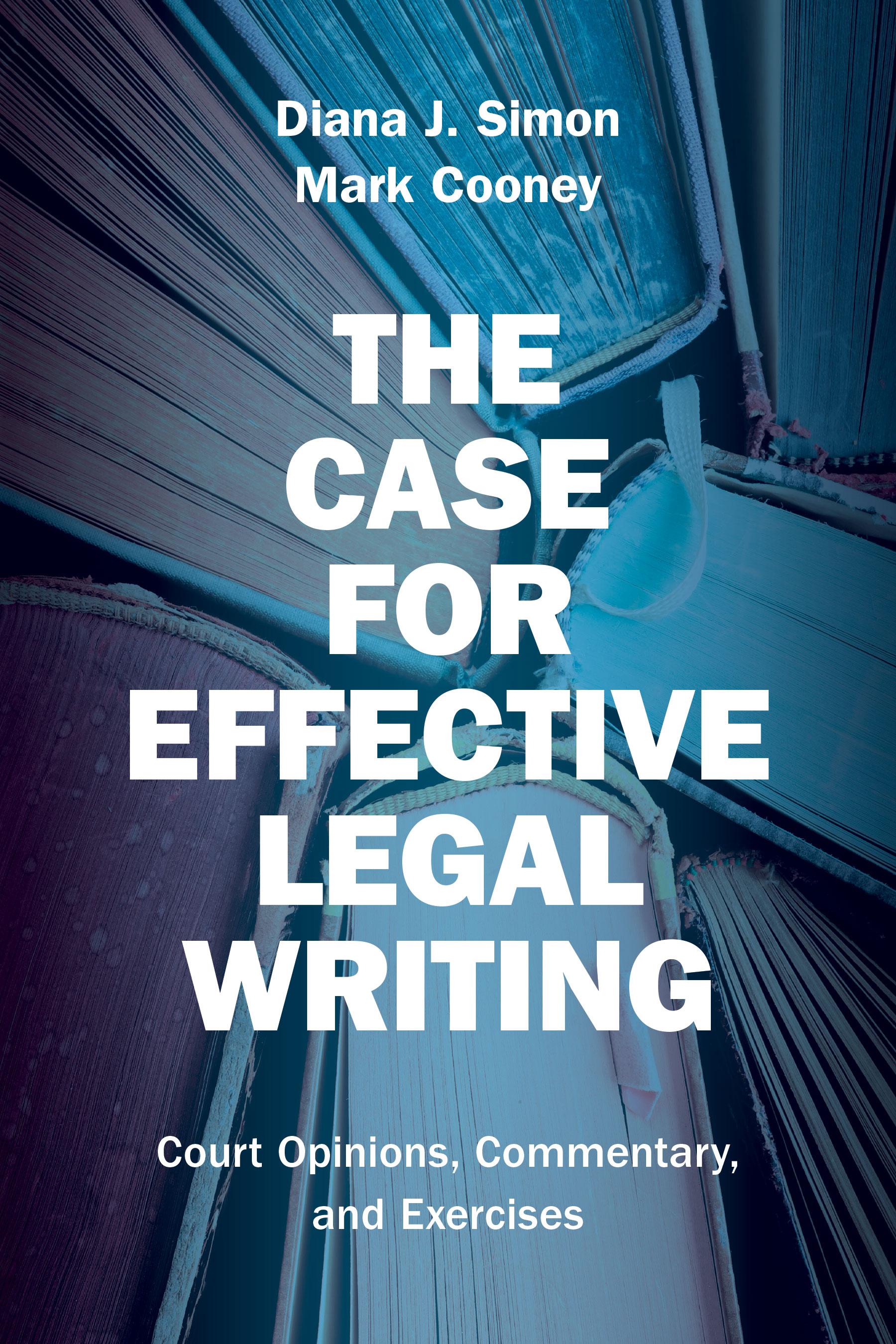 The Case for Effective Legal Writing
by
Welcome to a book that brings the courthouse to the legal writing classroom. The Case for Effective Legal Writing is the first of its kind, a text that connects writing technique to real-world consequences. In its pages, you'll find dozens of court cases in which writing technique determined the outcome or was otherwise significant--cases proving that the finer points of writing mechanics and legal style aren't trivial or mere fancies of personal taste. In short, this book will be Exhibit A when professors tell students that legal writing is every bit as important as the doctrinal law it shapes. The book devotes chapters to writing techniques and issues that law students invariably wrestle with: tone, diction, succinctness, grammar, syntax, punctuation, and more. Each chapter features an illustrative case or cases, edited for readability and focus. The case excerpts are preceded by explanatory passages and are followed by notes, questions, and practical exercises. The book is sure to prompt rich and useful conversations in and out of the classroom. And the writing lessons that emerge will stick, given their newly evident real-world implications. After reading these cases, students will never again see usage, mechanics, and style as ancillary afterthoughts. Professors can use this book in any legal writing course, whether a first-year offering or an advanced course. Its cases and lessons will enhance instruction on everything from memos and court briefs to contracts and legislation. It will also be a useful and practical resource for AJD, LLM, and MLS students.
Call Number: Treatises ; KF250 .S533 2024ISBN: 9781531028336Publication Date: April 1, 2024
The Case for Effective Legal Writing
by
Welcome to a book that brings the courthouse to the legal writing classroom. The Case for Effective Legal Writing is the first of its kind, a text that connects writing technique to real-world consequences. In its pages, you'll find dozens of court cases in which writing technique determined the outcome or was otherwise significant--cases proving that the finer points of writing mechanics and legal style aren't trivial or mere fancies of personal taste. In short, this book will be Exhibit A when professors tell students that legal writing is every bit as important as the doctrinal law it shapes. The book devotes chapters to writing techniques and issues that law students invariably wrestle with: tone, diction, succinctness, grammar, syntax, punctuation, and more. Each chapter features an illustrative case or cases, edited for readability and focus. The case excerpts are preceded by explanatory passages and are followed by notes, questions, and practical exercises. The book is sure to prompt rich and useful conversations in and out of the classroom. And the writing lessons that emerge will stick, given their newly evident real-world implications. After reading these cases, students will never again see usage, mechanics, and style as ancillary afterthoughts. Professors can use this book in any legal writing course, whether a first-year offering or an advanced course. Its cases and lessons will enhance instruction on everything from memos and court briefs to contracts and legislation. It will also be a useful and practical resource for AJD, LLM, and MLS students.
Call Number: Treatises ; KF250 .S533 2024ISBN: 9781531028336Publication Date: April 1, 2024 -
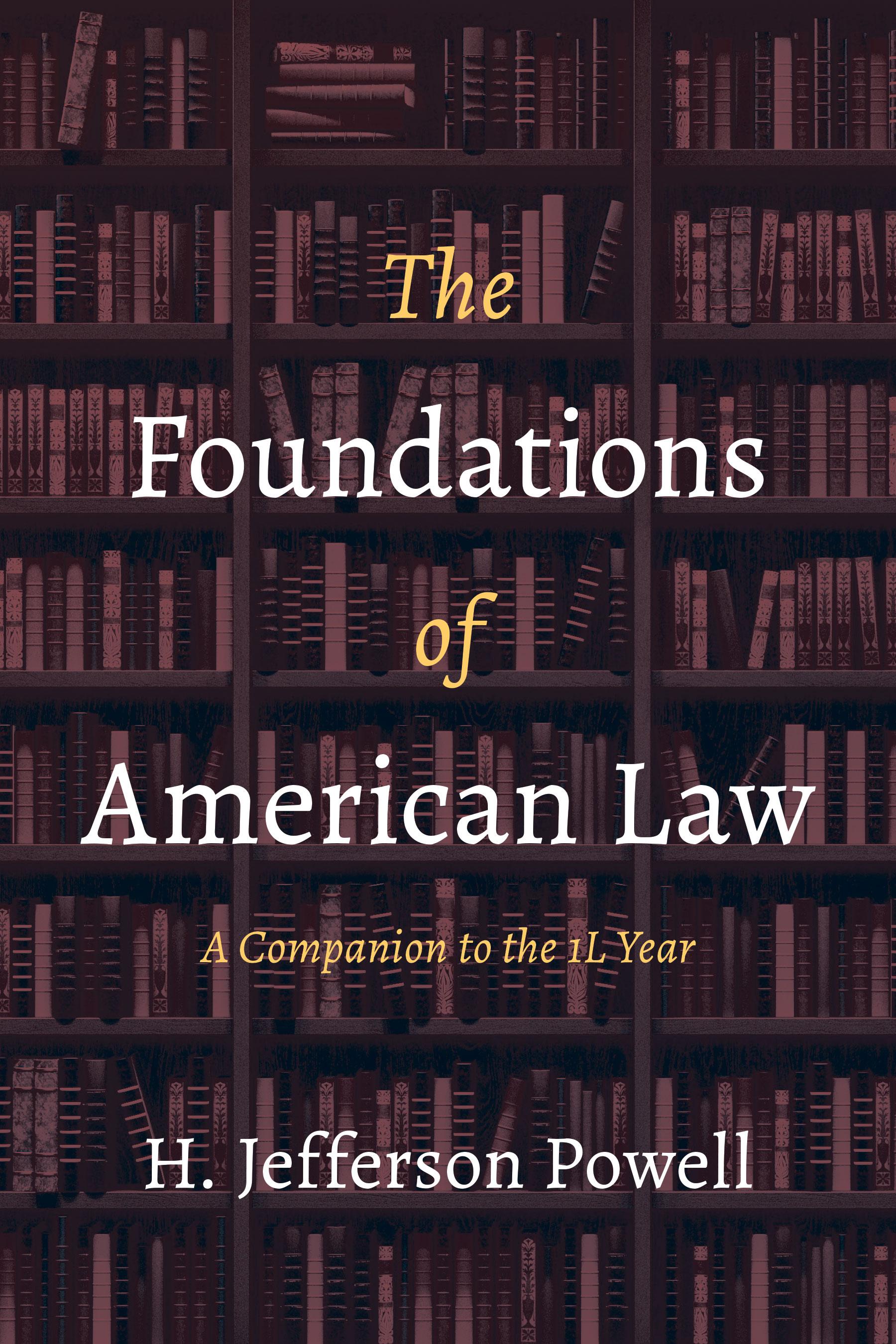 The Foundations of American Law: A Companion to the 1L Year
by
The main objective of this text is to introduce the reader to many of the background assumptions about American law and legal argument that inform how lawyers and judges read decisions and other legal documents, and how they think about legal problems. Lawyers presuppose and use these ideas and intellectual tools without discussing them, while law professors (and the materials they assign) often leave it to students to figure out the assumptions for themselves. The book discusses the relationship between logic and historical experience in the construction of the law, the ways pre-Revolutionary English common law shaped American law, and the 19th and early 20th century developments that led to contemporary American law. The reader will also come away with a clear sense of the ways in which lawyers use "lawtalk" (the characteristic ways lawyers imagine, analyze, and address problems) to make sense of events and issues that require legal attention or decision. While there are a number of books that introduce readers to American legal thought, none are as introductory, accessible, or broad-covering as The Foundations of American Law: A Companion to the 1L Year. This book is primarily intended for first year law students, but will also be interesting to people considering law school or those who are simply interested in how lawyers and judges think and make decisions.
Call Number: Treatises ; KF380 .P685 2024ISBN: 9781531029517Publication Date: February 1, 2024
The Foundations of American Law: A Companion to the 1L Year
by
The main objective of this text is to introduce the reader to many of the background assumptions about American law and legal argument that inform how lawyers and judges read decisions and other legal documents, and how they think about legal problems. Lawyers presuppose and use these ideas and intellectual tools without discussing them, while law professors (and the materials they assign) often leave it to students to figure out the assumptions for themselves. The book discusses the relationship between logic and historical experience in the construction of the law, the ways pre-Revolutionary English common law shaped American law, and the 19th and early 20th century developments that led to contemporary American law. The reader will also come away with a clear sense of the ways in which lawyers use "lawtalk" (the characteristic ways lawyers imagine, analyze, and address problems) to make sense of events and issues that require legal attention or decision. While there are a number of books that introduce readers to American legal thought, none are as introductory, accessible, or broad-covering as The Foundations of American Law: A Companion to the 1L Year. This book is primarily intended for first year law students, but will also be interesting to people considering law school or those who are simply interested in how lawyers and judges think and make decisions.
Call Number: Treatises ; KF380 .P685 2024ISBN: 9781531029517Publication Date: February 1, 2024 -
 Legal Analysis: 100 Exercises for Mastery
by
This new edition provides varied legal analysis exercises--with answers--that professors can assign either alone or as part of a series to refine students' analysis skills. The second edition adds eighteen bonus exercises, all of which are designed to be completed within about one class period. Using these "one-class wonders," professors can assign legal analysis practice even with just one class period to spare. For problems with greater depth, professors can turn to the one-class wonders with pre-work. The main volume contains annotated answers to all even-numbered problems, so students can assess their own work; odd answers are reserved for the accompanying teacher's manual.
Call Number: Treatises ; KF240 .H533 2017ISBN: 9781632849472Publication Date: September 1, 2017
Legal Analysis: 100 Exercises for Mastery
by
This new edition provides varied legal analysis exercises--with answers--that professors can assign either alone or as part of a series to refine students' analysis skills. The second edition adds eighteen bonus exercises, all of which are designed to be completed within about one class period. Using these "one-class wonders," professors can assign legal analysis practice even with just one class period to spare. For problems with greater depth, professors can turn to the one-class wonders with pre-work. The main volume contains annotated answers to all even-numbered problems, so students can assess their own work; odd answers are reserved for the accompanying teacher's manual.
Call Number: Treatises ; KF240 .H533 2017ISBN: 9781632849472Publication Date: September 1, 2017 -
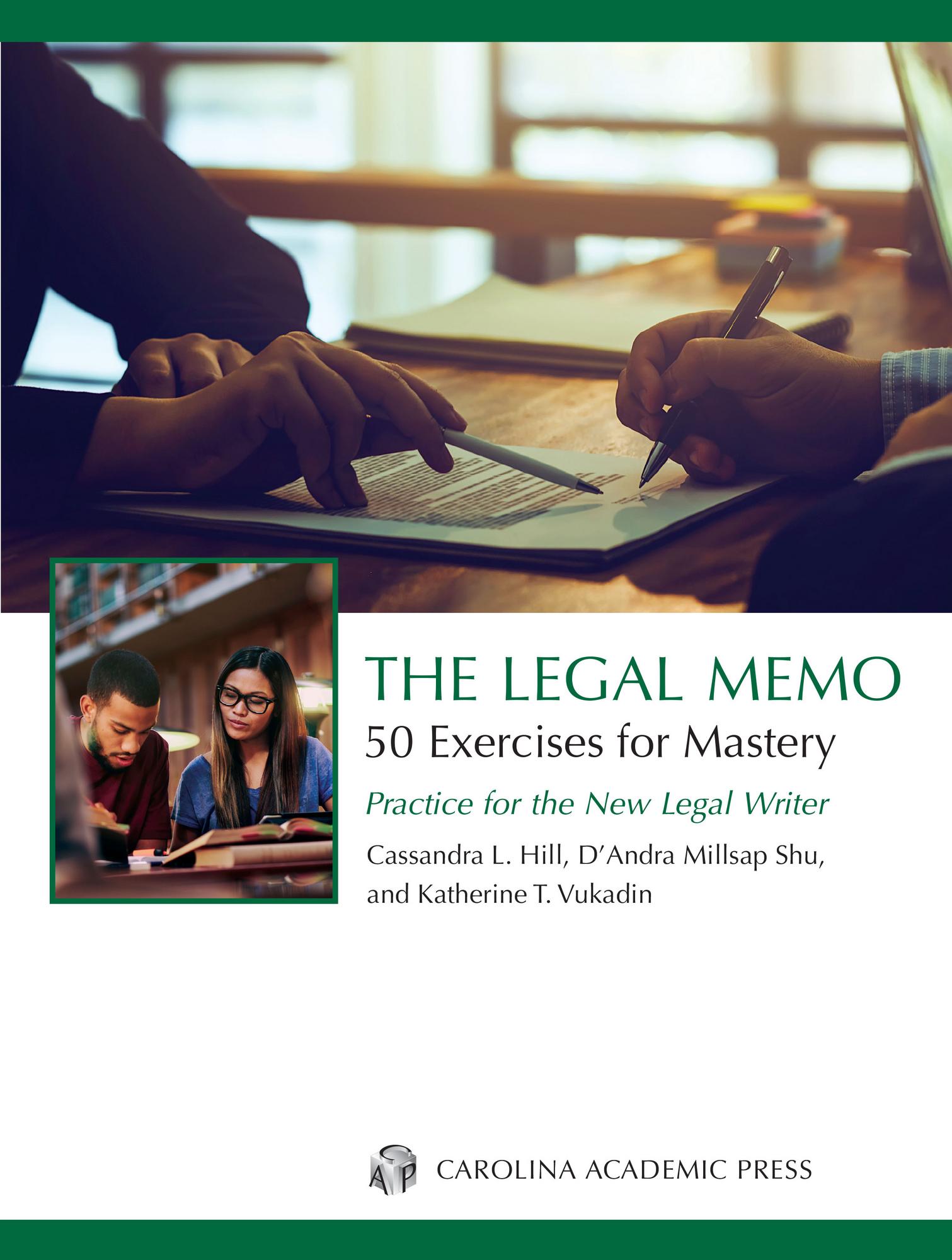 The Legal Memo: 50 Exercises for Mastery
by
To write an effective memo, legal writers must first master a series of distinct and crucial skills: fact selection, narrowing of the specific legal issue, correct rule formulation, and accurate application of law to the client's facts, to name but a few. This book provides the practice new legal writers need. The book contains fifty exercises, most of which can be done lightning-round style, taking just fifteen minutes. For more in-depth practice, the book also contains exercises taking about thirty minutes; these take a deeper dive into the material and bring together several different skills. Each exercise is independent, so students and professors will have little ramp-up time and can get right into the skills practice. Half the exercises have annotated sample answers in the back of the book, so writers can check their work. All exercises have been tested on law students. Using this book, legal writers can practice what they have learned from professors and primary casebooks. Any legal writer using these exercises will develop a keen understanding of the memo's various components and necessary skills.
Call Number: Treatises ; KF250 .H55 2021ISBN: 9781531016838Publication Date: December 14, 2020
The Legal Memo: 50 Exercises for Mastery
by
To write an effective memo, legal writers must first master a series of distinct and crucial skills: fact selection, narrowing of the specific legal issue, correct rule formulation, and accurate application of law to the client's facts, to name but a few. This book provides the practice new legal writers need. The book contains fifty exercises, most of which can be done lightning-round style, taking just fifteen minutes. For more in-depth practice, the book also contains exercises taking about thirty minutes; these take a deeper dive into the material and bring together several different skills. Each exercise is independent, so students and professors will have little ramp-up time and can get right into the skills practice. Half the exercises have annotated sample answers in the back of the book, so writers can check their work. All exercises have been tested on law students. Using this book, legal writers can practice what they have learned from professors and primary casebooks. Any legal writer using these exercises will develop a keen understanding of the memo's various components and necessary skills.
Call Number: Treatises ; KF250 .H55 2021ISBN: 9781531016838Publication Date: December 14, 2020 -
 Level up Your Legal Writing
by
Unlock the power of legal writing. From drafting memos to honing an appellate brief, Aspen Publishing's Level Up Your Legal Writing: Techniques and Technology to Supercharge Your Skills goes beyond the basics with highly effective techniques for amplifying your message, animating your narrative, and leveraging AI and tech tools to elevate your craft. Grounded in more than a decade of research by Joe Regalia, co-founder of Write.law, these tools have been used to transform how law students, paralegals, lawyers, and judges level up their writing style, develop their own authentic voice, connect with their reader, leverage technology, and learn to enjoy the writing process once again--or for the first time. Joe and the Write.law team use these same strategies to train the top legal writers in the world: from Fortune 100 in-house teams to federal trial and appellate courts to the top AmLaw firms and everything in between. And now, this playbook for the best legal writing is available to you. With a forward-thinking, integrated approach to the role of technology readers will be prepared to thrive in today's rapidly evolving, high-tech legal landscape. Readers will benefit from: Complete coverage of legal writing, from rule synthesis and storytelling to the mechanics of writing and advanced rhetorical style; leveling up the structure, design, and style of legal documents with sample memos, motions, and briefs; hundreds of examples from an array of leading legal writers that demonstrate each principle and technique; the "how and why" of each technique, so you can make informed choices when using them; a step-by-step guide to the writing process, from brainstorming and outlining to drafting and editing the final product; a focus on using technology efficiently and appropriately throughout the writing process; chapter-by-chapter Write.law tutorials and exercises intended to help students practice every technique iteratively and interactively.
Call Number: Treatises ; KF250 .R425 2025ISBN: 9798889061113Publication Date: September 23, 2024
Level up Your Legal Writing
by
Unlock the power of legal writing. From drafting memos to honing an appellate brief, Aspen Publishing's Level Up Your Legal Writing: Techniques and Technology to Supercharge Your Skills goes beyond the basics with highly effective techniques for amplifying your message, animating your narrative, and leveraging AI and tech tools to elevate your craft. Grounded in more than a decade of research by Joe Regalia, co-founder of Write.law, these tools have been used to transform how law students, paralegals, lawyers, and judges level up their writing style, develop their own authentic voice, connect with their reader, leverage technology, and learn to enjoy the writing process once again--or for the first time. Joe and the Write.law team use these same strategies to train the top legal writers in the world: from Fortune 100 in-house teams to federal trial and appellate courts to the top AmLaw firms and everything in between. And now, this playbook for the best legal writing is available to you. With a forward-thinking, integrated approach to the role of technology readers will be prepared to thrive in today's rapidly evolving, high-tech legal landscape. Readers will benefit from: Complete coverage of legal writing, from rule synthesis and storytelling to the mechanics of writing and advanced rhetorical style; leveling up the structure, design, and style of legal documents with sample memos, motions, and briefs; hundreds of examples from an array of leading legal writers that demonstrate each principle and technique; the "how and why" of each technique, so you can make informed choices when using them; a step-by-step guide to the writing process, from brainstorming and outlining to drafting and editing the final product; a focus on using technology efficiently and appropriately throughout the writing process; chapter-by-chapter Write.law tutorials and exercises intended to help students practice every technique iteratively and interactively.
Call Number: Treatises ; KF250 .R425 2025ISBN: 9798889061113Publication Date: September 23, 2024 -
 Mock Trials: Preparing, Presenting, and Winning Your Case
by
The key to victory in a mock trial begins with preparation weeks, sometimes months, before a competitor begins their opening statement. Long before the prevailing party calls its first witness, the foundation for understanding the facts and preparing to admit and challenge the evidence is built. All the tools needed for success are laid out in this guidebook to greatness. Using diagrams, charts, and checklists, the third edition of Mock Trials provides an updated, step-by-step guide to preparing, presenting, and winning trial competitions at every level. Practice tips provide methods to demonstrate to the judge your thorough understanding of the case, the rules of evidence, and courtroom procedure. Starting with the basics of how trials work and courtrooms are set up, Mock Trials walks through the entire process, from case preparation and research, to the rules of evidence and procedure, communication skills, and pretrial motions. You will learn how to examine your witnesses, raise evidentiary objections, introduce exhibits, and cross-examine opposing witnesses, including experts. This third edition also adds guidance for serving as an effective witness and preparing witnesses to testify at trial. From the time you make your opening statement to the conclusion of your closing argument, this manual is the resource you need for the direction and confidence to succeed. It is clear enough to assist those new to trial competitions yet sufficiently robust that practicing attorneys also keep a copy on hand for easy reference.
Call Number: Treatises ; KF281 .L83 2024ISBN: 9798886690576Publication Date: June 27, 2024
Mock Trials: Preparing, Presenting, and Winning Your Case
by
The key to victory in a mock trial begins with preparation weeks, sometimes months, before a competitor begins their opening statement. Long before the prevailing party calls its first witness, the foundation for understanding the facts and preparing to admit and challenge the evidence is built. All the tools needed for success are laid out in this guidebook to greatness. Using diagrams, charts, and checklists, the third edition of Mock Trials provides an updated, step-by-step guide to preparing, presenting, and winning trial competitions at every level. Practice tips provide methods to demonstrate to the judge your thorough understanding of the case, the rules of evidence, and courtroom procedure. Starting with the basics of how trials work and courtrooms are set up, Mock Trials walks through the entire process, from case preparation and research, to the rules of evidence and procedure, communication skills, and pretrial motions. You will learn how to examine your witnesses, raise evidentiary objections, introduce exhibits, and cross-examine opposing witnesses, including experts. This third edition also adds guidance for serving as an effective witness and preparing witnesses to testify at trial. From the time you make your opening statement to the conclusion of your closing argument, this manual is the resource you need for the direction and confidence to succeed. It is clear enough to assist those new to trial competitions yet sufficiently robust that practicing attorneys also keep a copy on hand for easy reference.
Call Number: Treatises ; KF281 .L83 2024ISBN: 9798886690576Publication Date: June 27, 2024


Legal History
-
Empire of Purity: The History of Americans' Global War on Prostitution
by
Between the 1870s and 1930s, American social reformers, working closely with the US government, transformed sexual vice into an international political and humanitarian concern. As these activists worked to eradicate prostitution and trafficking, they promoted sexual self-control for both men and women as a cornerstone of civilization and a basis of American exceptionalism. Empire of Purity traces the history of these efforts, showing how the policing and penalization of sexuality was used to justify American interventions around the world. Eva Payne describes how American reformers successfully pushed for international anti-trafficking agreements that mirrored US laws, calling for states to criminalize prostitution and restrict migration, and harming the very women they claimed to protect. She argues that Americans' ambitions to reshape global sexual morality and law advanced an ideology of racial hierarchy that viewed women of color, immigrants, and sexual minorities as dangerous vectors of disease. Payne tells the stories of the sex workers themselves, revealing how these women's experiences defy the dichotomies that have shaped American cultural and legal conceptions of prostitution and trafficking, such as choice and coercion, free and unfree labor, and white sexual innocence and the assumed depravity of nonwhites. Drawing on archives in Europe, the United States, and Latin America, Empire of Purity ties the war on sexual vice to American imperial ambitions and a politicization of sexuality that continues to govern both domestic and international policy today.
Call Number: Treatises ; HQ144 .P39 2024ISBN: 9780691256979Publication Date: November 12, 2024
-
The Foundations of American Law: A Companion to the 1L Year
by
The main objective of this text is to introduce the reader to many of the background assumptions about American law and legal argument that inform how lawyers and judges read decisions and other legal documents, and how they think about legal problems. Lawyers presuppose and use these ideas and intellectual tools without discussing them, while law professors (and the materials they assign) often leave it to students to figure out the assumptions for themselves. The book discusses the relationship between logic and historical experience in the construction of the law, the ways pre-Revolutionary English common law shaped American law, and the 19th and early 20th century developments that led to contemporary American law. The reader will also come away with a clear sense of the ways in which lawyers use "lawtalk" (the characteristic ways lawyers imagine, analyze, and address problems) to make sense of events and issues that require legal attention or decision. While there are a number of books that introduce readers to American legal thought, none are as introductory, accessible, or broad-covering as The Foundations of American Law: A Companion to the 1L Year. This book is primarily intended for first year law students, but will also be interesting to people considering law school or those who are simply interested in how lawyers and judges think and make decisions.
Call Number: Treatises ; KF380 .P685 2024ISBN: 9781531029517Publication Date: February 1, 2024
-
 Hot Dog Money: Inside the Biggest Scandal in the History of College Sports
by
The New York Times bestselling author of War Dogs exposes the inside story of disgraced fraudster turned undercover FBI informant Marty Blazer and the greatest scandal in the history of the NCAA. When the federal government catches hotshot financial adviser Louis Martin "Marty" Blazer defrauding his NFL-player clients, it's time to come clean. He has no reasonable defense. What he has is a bigger story to spill to the feds--that of a multibillion-dollar conspiracy that exploits the most talented college athletes and implicates one of the most popular entertainment industries in the nation. The DOJ is listening, and the truth could literally set Marty free. All he has to do is prove that the NCAA is a vast ongoing scam. Sent undercover by the FBI, Marty infiltrates the innermost circles of college basketball, a high-flying world of Miami clubs, New York luxury suites, and Las Vegas back rooms. Over a period of three years, covertly recording thousands of hours of conversations with coaches from many of the leading college teams, Marty reveals a large-scale epidemic of deception, bribery, and fraud within the NCAA. The stars seem aligned for the operation--if only Marty can keep the FBI itself from blowing the case. Journalist Guy Lawson digs deep into a true story about the lure of celebrity, sports, wealth, and crime, and the motivations of a man--on both sides of the law--who exploded a land mine of systemic all-American corruption.
Call Number: Treatises ; GV351 .L39 2024ISBN: 9781662519642Publication Date: June 1, 2024
Hot Dog Money: Inside the Biggest Scandal in the History of College Sports
by
The New York Times bestselling author of War Dogs exposes the inside story of disgraced fraudster turned undercover FBI informant Marty Blazer and the greatest scandal in the history of the NCAA. When the federal government catches hotshot financial adviser Louis Martin "Marty" Blazer defrauding his NFL-player clients, it's time to come clean. He has no reasonable defense. What he has is a bigger story to spill to the feds--that of a multibillion-dollar conspiracy that exploits the most talented college athletes and implicates one of the most popular entertainment industries in the nation. The DOJ is listening, and the truth could literally set Marty free. All he has to do is prove that the NCAA is a vast ongoing scam. Sent undercover by the FBI, Marty infiltrates the innermost circles of college basketball, a high-flying world of Miami clubs, New York luxury suites, and Las Vegas back rooms. Over a period of three years, covertly recording thousands of hours of conversations with coaches from many of the leading college teams, Marty reveals a large-scale epidemic of deception, bribery, and fraud within the NCAA. The stars seem aligned for the operation--if only Marty can keep the FBI itself from blowing the case. Journalist Guy Lawson digs deep into a true story about the lure of celebrity, sports, wealth, and crime, and the motivations of a man--on both sides of the law--who exploded a land mine of systemic all-American corruption.
Call Number: Treatises ; GV351 .L39 2024ISBN: 9781662519642Publication Date: June 1, 2024 -
Pardon Power
by
The president's power to pardon federal crimes is immense, with roots in ancient notions of mercy and amnesty. However, this power, seemingly boundless under the Constitution, lacks clear constraints, inviting concerns about abuse. Recent discussions in the U.S. Supreme Court have raised alarms about the potential for presidential abuse of pardons, highlighting the need for accountability within the pardon system to uphold the foundational premise that no one is above the law. Pardon Power: How the Pardon System Works-- and Why, Kim Wehle explores the historical context and contemporary challenges surrounding the presidential pardon. Wehle contends that any pardon undermining the principle of accountability before the law, including self-pardons, cannot be constitutionally justified. Urgent recognition of the necessity for guardrails around the pardon power is essential to safeguard American democracy.
Call Number: Treatises ; KF9695 .W44 2024ISBN: 9781954907508Publication Date: September 2, 2024
-
Social Movements and the Law: Talking about Black Lives Matter and #METOO
by
Black Lives Matter and #MeToo are two of the most prominent twenty-first-century social movements in the United States. On the ground and on social media, more people have taken an active stance in support of either or both movements than almost any others in the country's history. Social Movements and the Law brings together the voices of twelve scholars and public intellectuals to explore how Black Lives Matter and #MeToo unfolded--separately and together--and how they enrich, inform, and complicate each other. Structured in dialogues and punctuated with informative text boxes, illustrations, and discussion questions, this accessible guide to an increasingly influential area of the law centers rich intersectional analysis of both movements and prompts readers to undertake further reflection and conversation. At a time of heightened public attention to the broader scholarly study of human social behavior and interaction, this book shows rather than tells how people with different perspectives can engage one another with open minds and a generosity of spirit.
ISBN: 9780520385160Publication Date: November 12, 2024

Legal Research
-
Sports Betting: A Legal Research Guide
by
Because sports betting is developing differently state-by-state and within tribal gaming systems, this guide includes material covering a wide variety of sports betting models. Users will see both primary and secondary sources referencing sports wagering, sports pools, fantasy sports, sports lotteries, pari-mutuel sports betting, tribal gaming, casino gaming, sportsbooks, internet betting, mobile sports betting, sports gambling, and gaming generally. These terms are not intended to be used interchangeably. Instead, the researcher should carefully explore the language used in each jurisdiction, paying particular attention to statutory and regulatory definitions. Additionally, we have elected to focus on the law of sports betting from 2018 to present because of the magnitude of change following the Murphy decision. There is a substantial body of scholarship focusing on the state of sports betting before and during the PASPA era. Researchers interested in law and scholarship prior to 2018 can use many of the resources and strategies noted throughout this guide to delve into this earlier material. Finally, this guide includes materials from states in which sports betting is legal at the time of publication. The 12 states that do not permit sports betting have been omitted. It also excludes law related exclusively to traditional casino gaming, horseracing, and other types of gambling not directly connected to the performance of specific athletes or the outcome of athletic events.
Call Number: Treatises ; KF3992.A1 A53 2024ISBN: 9780837743226Publication Date: 2024
-
Arson and Fire Investigation: A Legal Research Guide
by
Arson is a violent crime that has caused millions of dollars in property damage and widespread injuries and fatalities. In 2022, 30,400 incidents of arson were reported by law enforcement agencies to the FBI's National Incident Based Reporting System (NIBRS). However, the crime of arson is difficult to investigate and prosecute as it involves many complex challenges. The FBI's Uniform Crime Report program reported an arson crime clearance rate in 2019 of 23.4%. As the field of fire investigation evolves and continues to become more solidly grounded in science, there is an increasing need for resource material for the professionals involved in legal action related to fire investigation and arson. The authors have put together critical references in one resource to aid professionals in the legal system, law enforcement, and fire investigation community. It is the hope of the authors that this reference will continue the improve the understanding of fire investigation and will assist in the challenging pursuit of truth in arson cases. This bibliography follows previous bibliographies with citations to both primary and secondary sources. We have included both scientific and legal sources for the readers of this bibliography.
Call Number: Treatises ; KF241 .F57 F57 2025ISBN: 9780837743264Publication Date: 2025
Practice of Law
-
A Comprehensive Guide to Wellness in Law
by
In the legal profession, the pursuit of justice often comes at a cost - a toll on the mental health and well-being of lawyers. Burnout, depression, and elevated rates of anxiety are critical issues affecting the legal community. This book explains why this is happening and what lawyers can do to manage the stress and anxiety which is endemic in the legal profession. This book offers a holistic approach to a solution for lawyers. Every lawyer is different and there is no "one size fits all" solution. In addressing a mental, emotional, physical, and spiritual approach, every lawyer can find what works for them. By focusing on neurological causes and solutions, lawyers are given tools that have been reserved for mental health professionals. This is a system that was designed for attorneys; however, it has been successfully applied in many different professions. This book serves as a wake-up call to the legal profession, shedding light on the concerning rates of burnout, depression, anxiety, and suicidal thoughts among lawyers. By understanding the real causes, implementing strategies for a healthier work environment, cultivating resilience, seeking support, and advocating for change, we can transform the legal profession into a more compassionate, supportive, and mentally healthy community. This book suggests that attorneys must do more than just change their behavior, they must change their minds. It is imperative for lawyers to understand that the mental and emotional health issues they face are not the result of weakness or failure. It is the result of poor training. This book provides the training they need to shift their perspective of the challenges of practicing law. While Covid was a catalyst for stress, anxiety, and burnout, it also has highlighted the need for change. This book provides that change.
Call Number: Treatises ; KF300 .R59 2024ISBN: 9781639055050Publication Date: September 17, 2024
-
 Lawyers As Leaders: Why it Matters and What it Takes
by
This book has two parts. The first part begins by addressing why leadership development and training are essential in preparing lawyers for the roles and responsibilities they will have in their careers. The following six chapters describe The Five Practices of Exemplary Leadership®, providing qualitative and quantitative evidence of how these leadership practices improve personal and organizational productivity and stature. This operational system for leadership forms an accessible and practical basis for learning to lead and becoming the best leader you can be. The five chapters in the second part address the context in which lawyers exercise leadership. For example, thinking about leading in client relationships, in internal relationships (such as within the law firm or corporate legal office), and public roles. Examined are vital issues regarding client development ethics, effective decision-making, building emotional intelligence, diversity, equity and inclusion, and handling conflicts and adversity. In the Afterword, we focus on developing and adopting a leadership development mindset necessary for leading in challenging times. We also offer perspectives on how to be a lawyer leader who positively impacts the legal profession and the world.
Call Number: Legal Practice ; KF298 .P65 2024ISBN: 9781639055074Publication Date: September 24, 2024
Lawyers As Leaders: Why it Matters and What it Takes
by
This book has two parts. The first part begins by addressing why leadership development and training are essential in preparing lawyers for the roles and responsibilities they will have in their careers. The following six chapters describe The Five Practices of Exemplary Leadership®, providing qualitative and quantitative evidence of how these leadership practices improve personal and organizational productivity and stature. This operational system for leadership forms an accessible and practical basis for learning to lead and becoming the best leader you can be. The five chapters in the second part address the context in which lawyers exercise leadership. For example, thinking about leading in client relationships, in internal relationships (such as within the law firm or corporate legal office), and public roles. Examined are vital issues regarding client development ethics, effective decision-making, building emotional intelligence, diversity, equity and inclusion, and handling conflicts and adversity. In the Afterword, we focus on developing and adopting a leadership development mindset necessary for leading in challenging times. We also offer perspectives on how to be a lawyer leader who positively impacts the legal profession and the world.
Call Number: Legal Practice ; KF298 .P65 2024ISBN: 9781639055074Publication Date: September 24, 2024

Property Law
-
Homelessness, Liberty and Property
by
In Homelessness, Liberty and Property, Terry Skolnik establishes a novel theory about the government's duties to end homelessness, maintain public property's value, and legitimize laws that regulate public space. In doing so, Skolnik provides new insight into how the property law system and the regulation of public space limit unhoused persons' freedom and political equality. The book deepens our understanding of how various areas of law, such as constitutional law, legal philosophy, criminal law, and property law, approach the reality of homelessness and advances original arguments to provide new justifications for the right to housing. Skolnik concludes by offering a set of concrete proposals for how the government can reduce the incidence of homelessness and treat unhoused persons with greater concern and respect.
Call Number: Treatises ; KF3742 .S56 2025ISBN: 9781009392679Publication Date: November 2021, 2024
Sports Law
-
Sports Betting: A Legal Research Guide
by
Because sports betting is developing differently state-by-state and within tribal gaming systems, this guide includes material covering a wide variety of sports betting models. Users will see both primary and secondary sources referencing sports wagering, sports pools, fantasy sports, sports lotteries, pari-mutuel sports betting, tribal gaming, casino gaming, sportsbooks, internet betting, mobile sports betting, sports gambling, and gaming generally. These terms are not intended to be used interchangeably. Instead, the researcher should carefully explore the language used in each jurisdiction, paying particular attention to statutory and regulatory definitions. Additionally, we have elected to focus on the law of sports betting from 2018 to present because of the magnitude of change following the Murphy decision. There is a substantial body of scholarship focusing on the state of sports betting before and during the PASPA era. Researchers interested in law and scholarship prior to 2018 can use many of the resources and strategies noted throughout this guide to delve into this earlier material. Finally, this guide includes materials from states in which sports betting is legal at the time of publication. The 12 states that do not permit sports betting have been omitted. It also excludes law related exclusively to traditional casino gaming, horseracing, and other types of gambling not directly connected to the performance of specific athletes or the outcome of athletic events.
Call Number: Treatises ; KF3992.A1 A53 2024ISBN: 9780837743226Publication Date: 2024